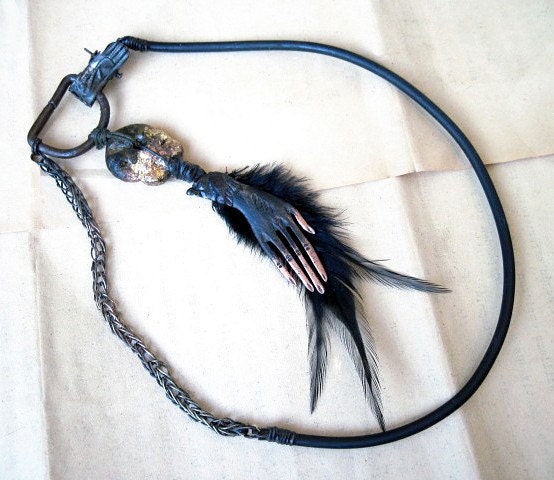
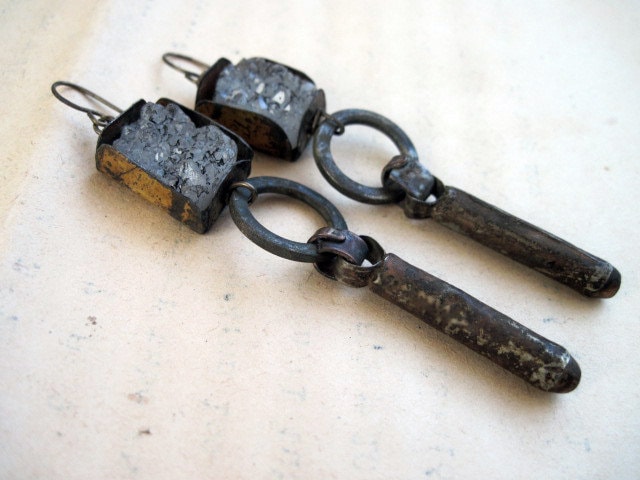
Showing posts with label esoteric historical or poetic. Show all posts

6/25/12

Mini batch and randoms.

Yes, Alice, 'fittingly' is a word and thank you so much for saying I have a knack for naming. Sometimes I don't know if others get it...
Oh, and I forgot to say, laura, I love you right back! Congrats to you for your son graduating kindergarten. Yeah, you deserve jewelry for managing to keep him alive and functioning for that long.
Beatnheart, the way I deal with tutorial or craft vids is just by fast-forwarding through most of it. They key will always be, like, nine tenths of the way through.
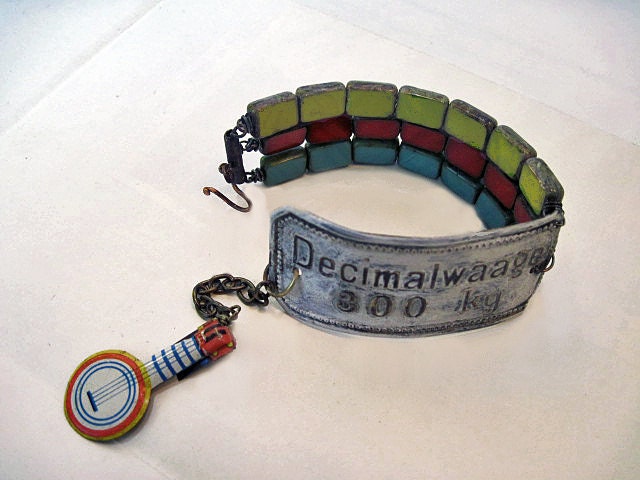
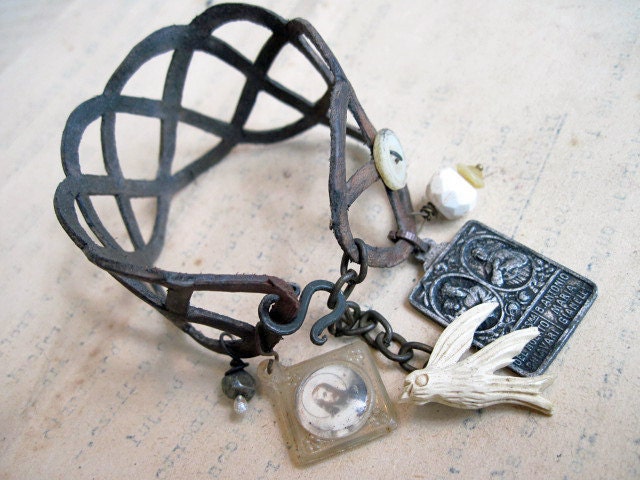
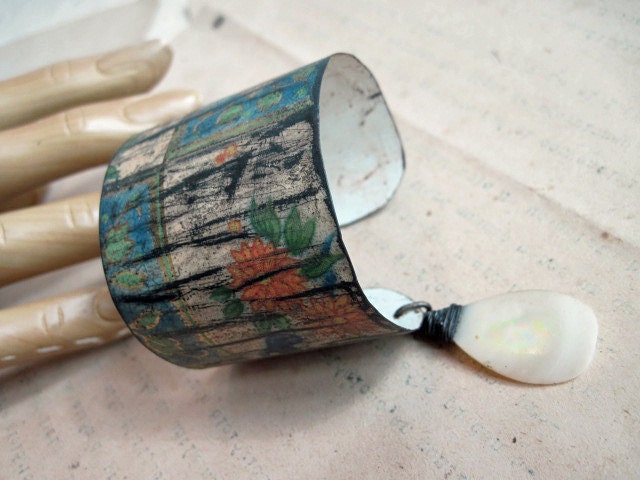
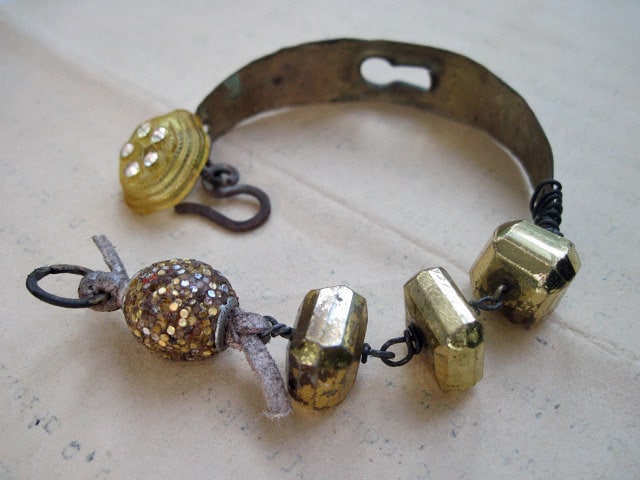
A Happy Song. Victorian Gypsy Rustic Tin Cuff with Tablet Window Colorful Czech Beads..
A Happy Song.
When searching for a title or quote to go with this bracelet, I stumbled upon this one, which while not appropriate for the listing, made me laugh out loud:
"Like, What is the least often heard sentence in the English language? That would be: Say, isn't that the banjo player's Porsche parked outside?"
-Jackson Browne
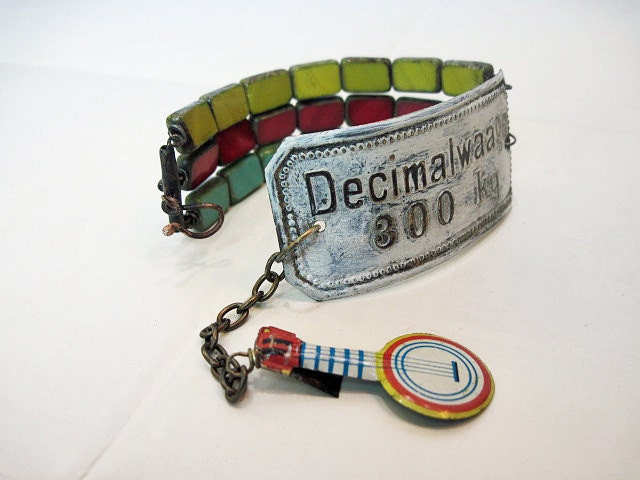
A Happy Song. Victorian Gypsy Rustic Tin Cuff with Tablet Window Colorful Czech Beads..I couldn't resist the color and repetitive shape of these tablet Czech babies. Man, every time I write Czech, it's an effort.
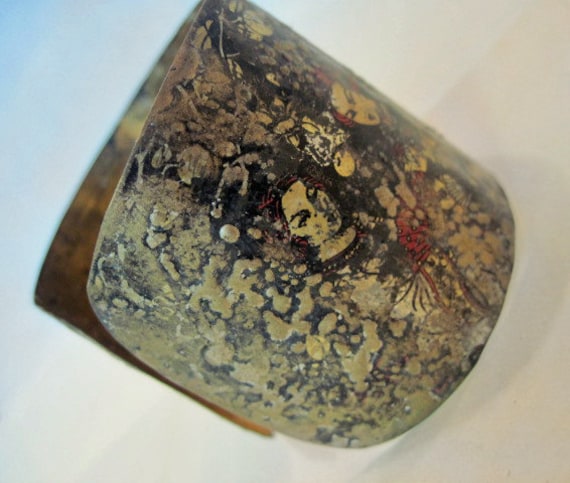
Twins. Recycled Rustic Tea Tin Cuff Bracelet.
And as usual, bracelets are maddening to photograph, what with having no back side and all. And as I get older, I seem to be loosing my own back side as well.
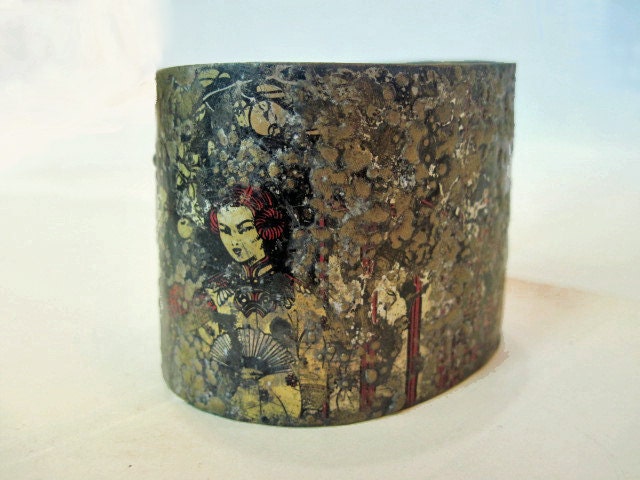
Twins. Recycled Rustic Tea Tin Cuff Bracelet.
So these have embezzling but then I fucked it up with smudgy alcohol inks I couldn't get rid of, so I went over that with gold rub-n-buff... Oy vey. Suffice it to say when I started this was a pristine tin given to me by SacredCake. Who OMG re-did her blog all over again and it looks so profesh and fancy and high-tech!
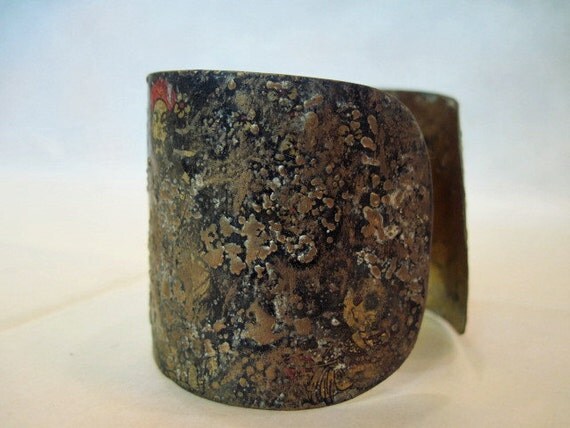
Twins. Recycled Rustic Tea Tin Cuff Bracelet.
Did I tell you all I was accepted to teach in Art n Soul at Virginia beach next year? Yay! But no, not yay cuz now I'm just nervous.
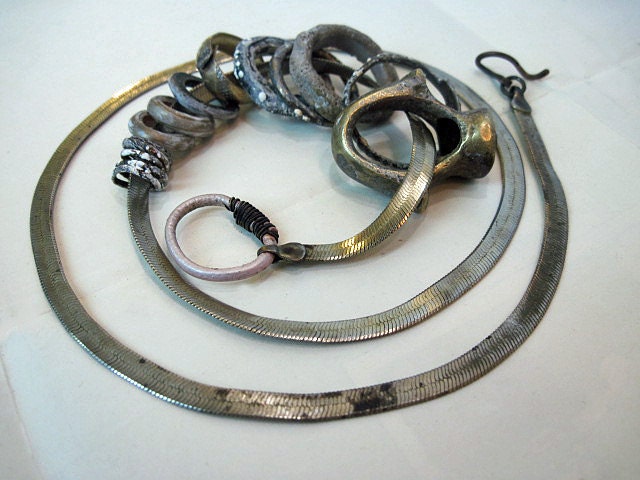
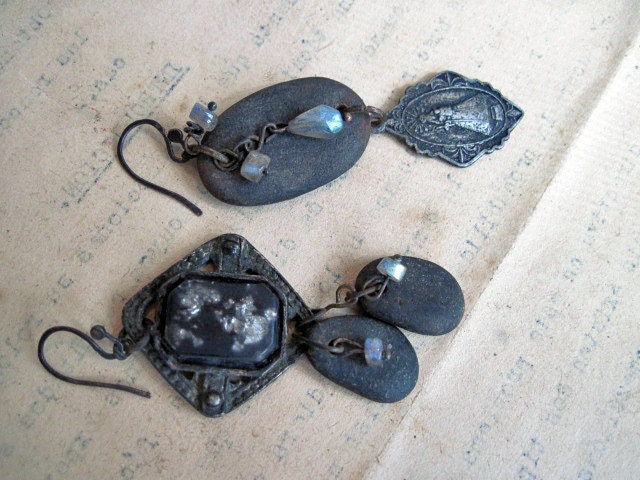
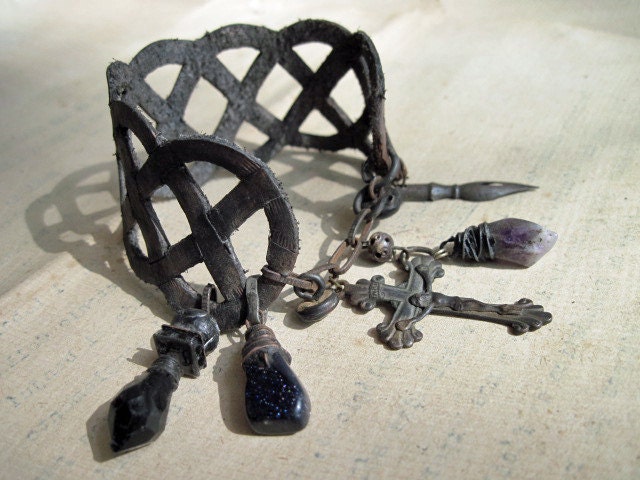
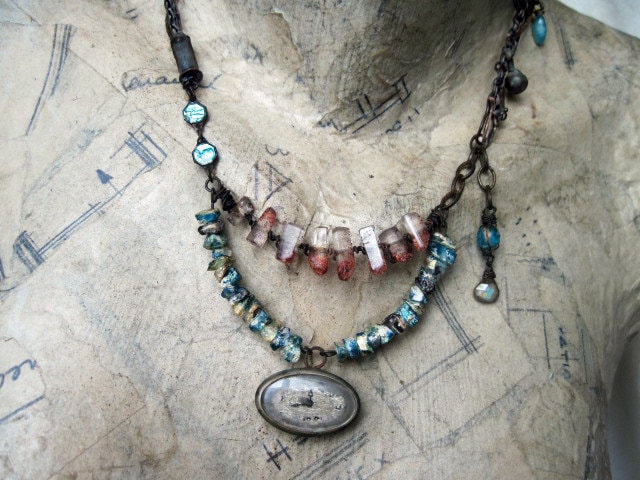
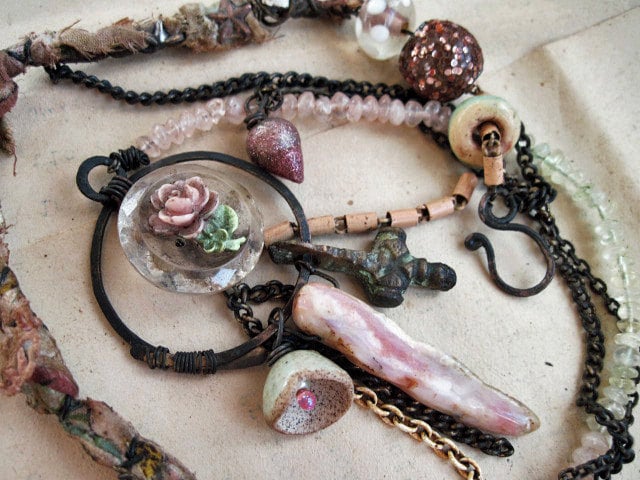
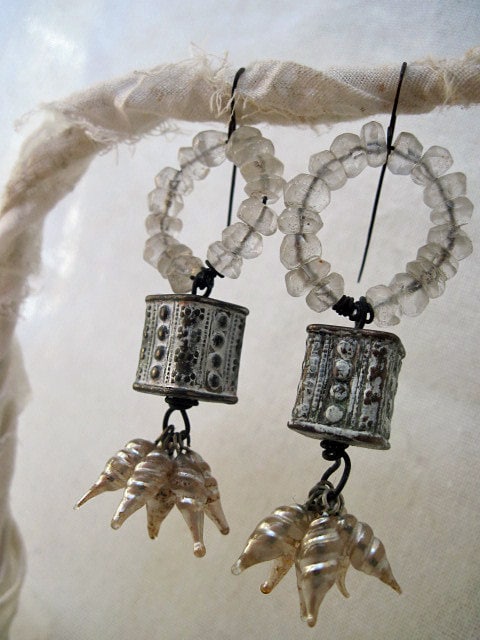
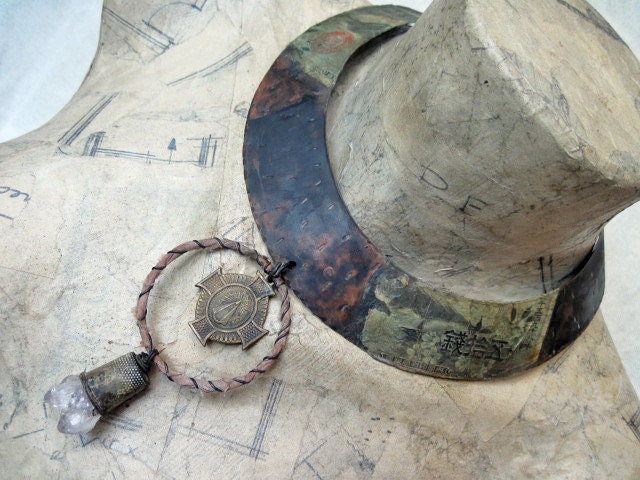
Ceremonial Magic. Rings and Hoops Rustic Choker.
Here's another hoopy one. Lots of embezzling.
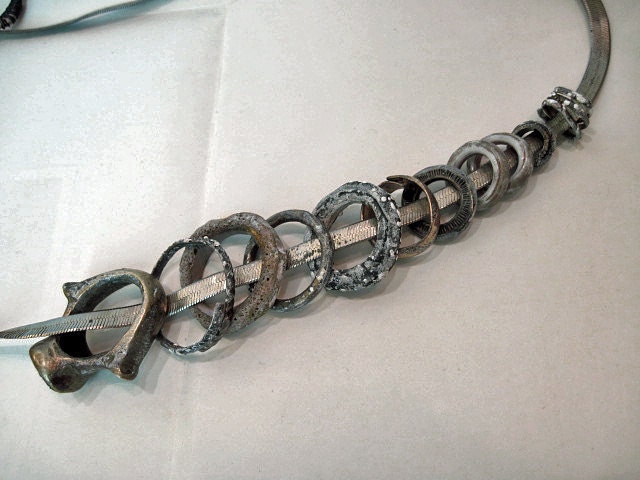
Ceremonial Magic. Rings and Hoops Rustic Choker.

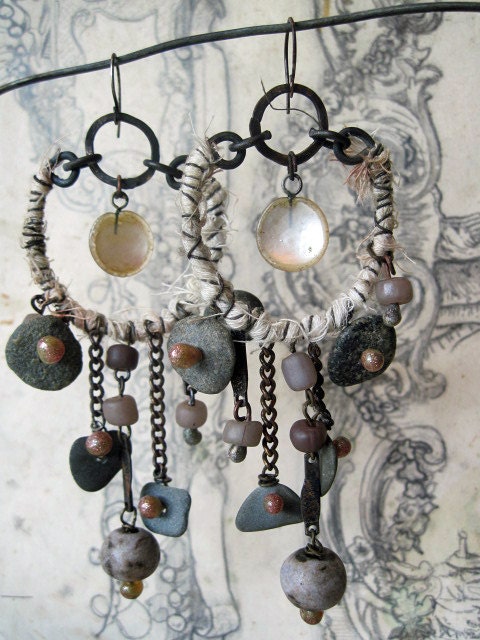
Check out these from 13Alternatives latest blog post.

"I've applied Fancifuldevices wonderful technique to earrings. I've got loads of odd, tiny beads at the bottom of my bead boxes, so I set about playing."

Which is exactly what the tute's all about! Use up those odds and ends.

My folks are back from an amazing time in Romania and the cats are all content. Had to share my two favorite pictures. The 1st is the cows walking home by themselves after a day of grazing.

Apparently if you get stuck behind them, you're screwed because they won't be hurried! Too redonk.
Now check out this black church. Is that not the prettiest most Satanic thing ever?


While I'm sharing randoms.... Tumblr is a great way to loose 5 or 6 hours at a time.
Oh, math. You cray cray. 
Oh, math. You cray cray.

(Gif and accompanying quote that I've been paraphrasing for my own ends from, via The Whole Blinking Cosmos, a tublr of pure awesomesauce, from whence I've stolen many a quote.)

(Segue way.)


"On April 25, somewhere in the ocean off Great Britain, a remotely operated video camera near a deep sea oil rig caught a glimpse — at first it was just a glimpse — of an astonishing looking sea creature. It was a green-gray blob of gelatinous muscle, covered with a finely mesh-like textured skin, no eyes, no tentacles, no front, no back. It moved constantly, floating up to the camera, then it backed off and disappeared. The camera operator tried to find it, and then, suddenly, out of the darkness, back it came."

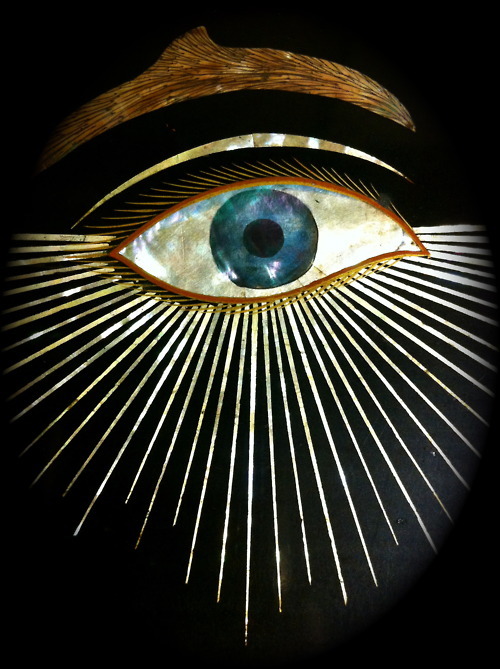
And you know I'm fully obsessed with the idea of eyes as symbols:
Here somewhere.

Batterfly Variation, Choleric

Batterfly Variation, Phlegmatic

The Dolphin Variation
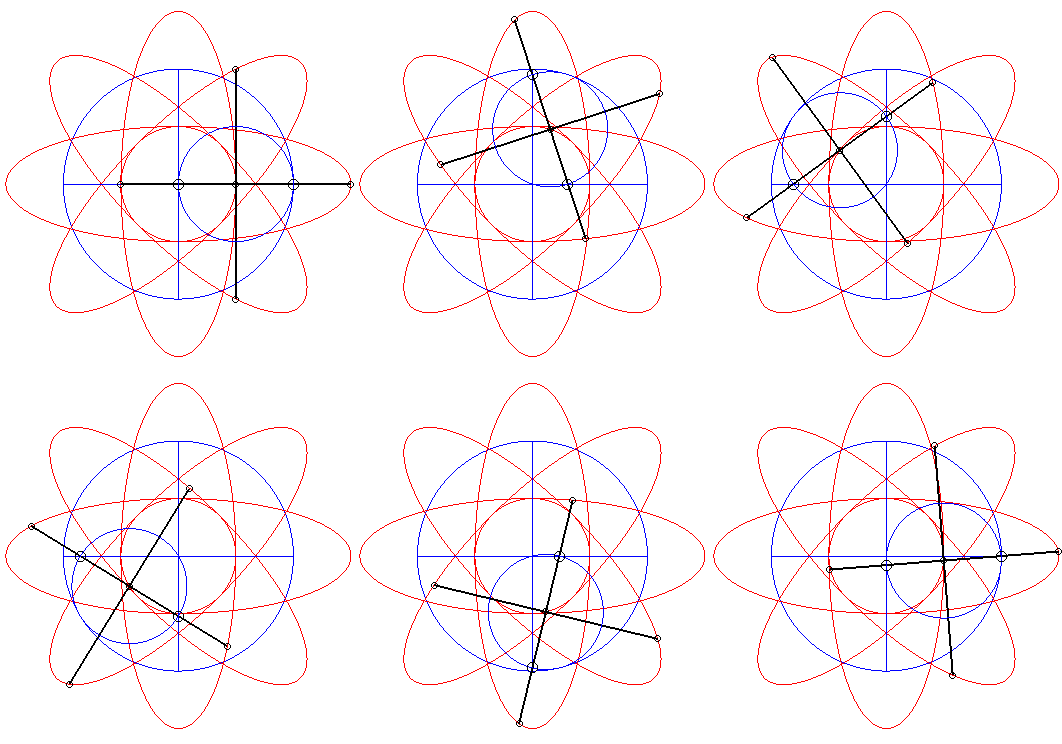
Four humors madness by Thomas Woodruff.

Finally, check out the scale of the universe and tremble.

1/5/12

Coming soon: eyeballs


I got me some creative ADD right now so be patient while I try to finish some tons stuff. I seem to be in a bits-making zone and less an assembling-bits-into-anything zone. Meanwhile, give some love to my friend Janet on her new blog and shop. Also my other friend Petra at her new blog.
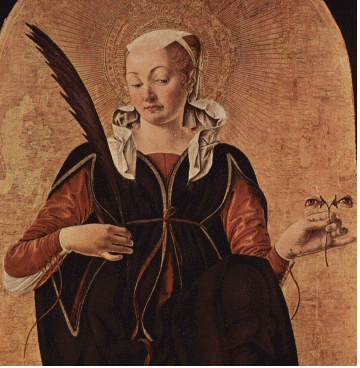
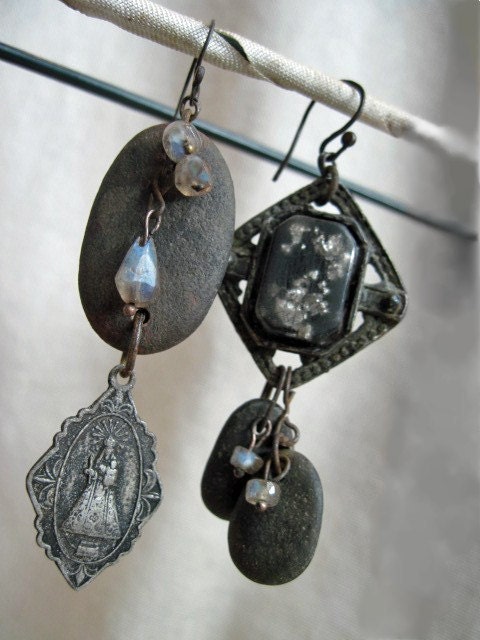
These St. Lucy's are for fancylinda.
While you're waiting for me, please also visit these insane amazing and super inspiring tumblrs I've recently discovered. Miss Mary Quite Contrary,  penabranca, and मण्डल. You will be glad you did. No, seriously. OK, fine whatever, don't spend 5 hours clicking through pictures, see if I care.


7/2/11

Entropy/order- chaos/pattern- predictability/surprise-boredom/interest...

OK, many of you in your comments (OK, 2 of you) asked about my ... well I guess the question is "What is it about your pieces?" And mentioned something about taking a class. Being a teacher, I instinctively encourage questions and I'm going to answer by divulging a bit about how I arrived at my aesthetic. Keep in mind that I'm self-taught (so I may be talking out my ass) and that not all of my pieces necessarily achieve my design ideals.

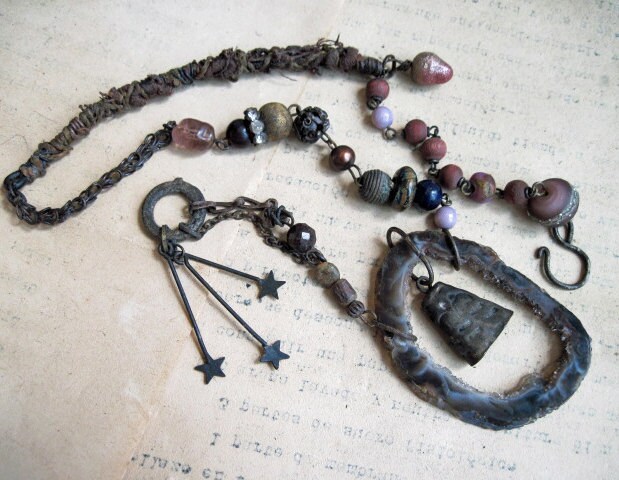
Cagastric.

Cagastric.
Cagastric.

When I first started, a big revelation I had was that I could pull out all the pictures of jewelry that I liked, that I found inspiring and amazing, lay them out side-by-side and systematically discover what they all had in common. What I realized was that I loved the wabi-sabi of the imperfect, handmade element. The unexpected, no-before-seen (i.e. a new style of bead or bezel) as well as something so old it was made new in that presentation (i.e. a classic sacred heart). I looked hard- with a knit brow and sharply focused eyes- it isn't easy to look analytically at the things that strike you as beautiful. I used to do that to faces as a child- I'd search the face to try and uncover a harmony that harbored the secret to the intensity of the person's appeal, and sometimes it was disturbing. I'd feel an ache in my stomach, a nausea. I remember seeing posters of Marilyn Monroe and looking until I just couldn't look anymore.


Keith Lo Bue
I was helpless to do anything but wonder at faces. Jewelry, on the other hand, I've slowly been able to figure out. Look at the work of Keith Lo Bue and you think it looks ancient, although it clearly isn't. So you ask yourself- why does it look ancient? What is it about these objects? One thing is you see a complete lack of reflective surface. All kinds of dull grungy browns with nothing shiny- not even the glass that is often used. I had no opinion about shine before but as I compared my pieces before and after oxidation, or bits of glass and resin before and after waxing, I started to see how distracting that shine is to the eye that's trying to uncover an overall design logic. And it makes sense realizing that anything found in, say, an archeological dig will never have a reflective polish. That was just one detail among many that I analyzed to the point of satisfactory conclusion.


Nubivagant.
Nubivagant.

OK, lets talk about overall design harmony. I just now went to etsy and typed "antique bracelet" , focusing at about the $70-$100 range, as that is where the most interesting designs are found in my experience. Right away I saw things I didn't like. Mostly it was too consistent- an array of charms and dangles that remained the same over the entire length of the bracelet. Basically, the eye figured it out too quickly, no more to examine or be mystified with, nothing to pull you in- the way trying to understand the beauty of faces pulled me in as a child. That means that to escape this design mistake, I have to change it up along the length. Being a bracelet (since these questions came up from bracelets I made), we're talking about a short length, so one area of focus works (although other things work too!). Since the clasp needs to be there like it or not, I've found it's a good area to place the focus. If I aim the focus opposite the clasp, then I have 2 competing points for the eye. Now that could work, as long as I have some underlying reason or something I'm "going with" in that design, but in the case of these, I don't, so clasp it is....

Aeipathy.
Aeipathy.

There should also be an underlying color scheme. The ones at work in the above 2 bracelets  are "ivory" and "dark" (seeing as actual "black" and "white" are too clean for my archeologist's aesthetic). However, notice that while the 1st bracelet's scheme for the hanging charms is light, it has a dark rectangular piece to sort of subvert that scheme. That is, the pattern is only slightly there, keeping our eyes on their toes. And while the second one is mostly dark brown, it includes dark purple and blue as well as black for variation. The 2nd also has "long shit" as a principle (yeah, that's what I said) and that is subverted by 2 shoe buttons and a carved horn bead, again, keeping the eye interested. It's as if the eye has to go, "Ok, long things. Wait-that's not long. Was I right about the long things? Let me re-check..." at which point it has to look at the piece again to make sure there's enough long things to make up a design principle. All this is time your eye has been busy and entertained. So maybe the principle can be stated as: "Come up with a rule, then break it a little." I guess. In any case, that is what the title of this post refers to.
(Maybe you'll understand better if I use some more quotation marks? Yeah.)

Magophony.
Magophony. 
It really helps to look at tons of stuff and say overtly to yourself what you do and don't like about each. And make a ton of stuff and a couple days after making each decide what works and what doesn't. You can do this right away by looking back at your work from when you started up to last week. I know, we cringe, but it helps.
Also, say you decide to make something similar to an inspiring piece you see on etsy- we all do it, it's how we learn. Carefully compare your results to the original piece. You might think yours sucks. But why? What about it isn't as good as the one that inspired you, what does the original have that yours doesn't? Often it consists of many little details or something that doesn't seem important enough to make such an impact. For me, I didn't think a bit of shine would be so important. But it was. So there. And you'll take that lesson into your next attempt which will suck a bit less.

Boscaresque. Tea Tin Cuff.

Your homework for today- look at antique bracelets in the $70-$100 range. Focus on color, shine, consistency of design. Make a pile you like and a pile you hate. Write in one or 2 sentences what it is you like about the items in your like pile (can be a sentence for each, but try to write at least one for several or all the items) and what you don't like about your hate pile (there might be more variety of reasons here, so more sentences).
Assignments due on Monday.
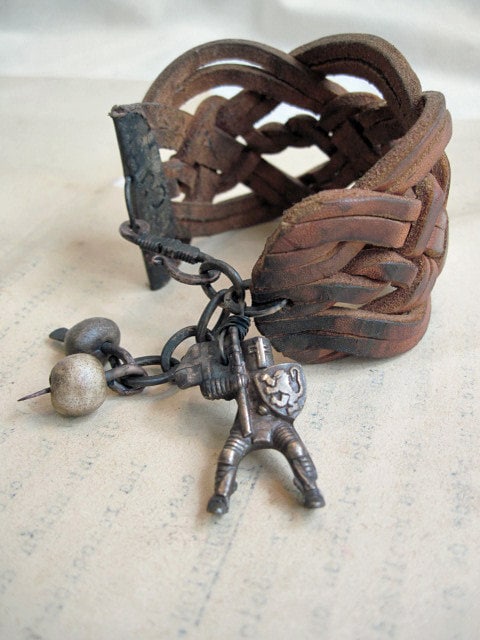
Salute. Leather Cuff with Knight.
Salute.
Class dismissed.

6/20/11

Thank You Richelle

-for turning me on to Matthea Harvey. Contemporary poems for when your mind wants to go wandering not by skipping-which will only get you to the blandest landscapes- but rather hiking. 
This gem here reminded me of the one that follows it.


THE GEM IS ON PAGE SIXTY-FOUR

Ahem said the guards when anyone lingered too long
With their nose in a posy & then came the stuttered
Explanation was required if one seemed to be admiring
Anything could provoke a ticket even a certain glazing
Of the eye that seemed to signify some secret rapture
How the rupture between looking & looking had happened
Was a mystery (perhaps there had once been a sallow queen)
But it was best to wear dark sunglasses & mutter what a waste
Of marble when in the proximity of beauty even if it was
Necessary acts of loveliness such as trimming the olive trees
Were scheduled for Non-Moon nights so the silvery branches
In piles around the ladders wouldn’t have any added
Attraction between young men & women was now a case
Of smuggled petticoats & plain brown cakes that had
Icing on the inside & in the schoolyard children traded
Beauty Cards listing what page & book to look in for something
Scandalous things had happened in a town up north it was
Rumored that all the pretty girls had pranced down the cobbled
Hill holding gold picture frames around their faces & a man
Wi
th a cane began surreptitiously tracing where the sun was
Hitting the stones & then the mayor whispered that line of
Shakespeare into his wife’s ear & she looked momentarily
Sentimental outbreaks were not uncommon & there were crews
Trained in containment but they could never predict the next
One day they’d come upon a soda fountain each customer looking
At his or her fizzy drink with an expression of absolute bliss
Or two boys in a basement in ecstasy over something imaginary
Which couldn’t be taken away & poured down the sink


Evil Fate


To lift a weight so heavy, 


Would take your courage, Sisyphus!


Although one's heart is in the work, 


Art is long and Time is short.


Far from famous sepulchers 


Toward a lonely cemetery 


My heart, like muffled drums, 


Goes beating funeral marches.


Many a jewel lies buried 


In darkness and oblivion, 


Far, far away from picks and drills;

Many a flower regretfully 


Exhales perfume soft as secrets 


In a profound solitude.


— from Les Fleurs du Mal by Charles Baudelaire, translated by William Aggeler

Something about the idea of a hidden beauty vs. seen beauty, or what is or is not beauty.... It sometimes seems to me that if it isn't seen it might not exist. But our observing makes it so- like the quantum physicist's revelation that observing a particle changes it. 
If the bits I bought up in Uruguay weren't seen by anyone else as they were by me- which of course they weren't- were they not yet beautiful? So much of what I do is just gathering things up- is my choice of what to use the magic wand that creates "Art"?
By the way, Richelle's Blogger profile, which doesn't lead to her crazy awesome etsy shop in any way I can figure, lists her occupation as "debutante." I thought you should all know. Does the profile lead to a debutanting business? Hmm. 
Ok, but so far my fave is :

At the carnival, Robo-Boy sees only things he recognizes. The Ferris Wheel is an overgrown version of his own bells & whistle eyes. His Flashers, his mother calls them. The tilt-a-whirl is the angle his head tilts when the Flirt Program goes into effect, usually in the vicinity of a Cindy or a Carrie, though once he found himself tilting at the school librarian which caused him to wheel in reverse into the Civil War section knocking over a cart of books that were waiting to be shelved under B. There’s a dangerously low stratosphere of pink cotton-candy clouds being carried around by the children. If Robo-Boy goes near them, the alarms will go off. It’s a kind of sticky that would cause joint-lock for sure. In a darker, safer corner Robo-Boy finds the Whack-a-Mole game. He pays a dollar and starts whacking the plastic moles on their heads each time they pop up from the much-dented log. He wins bear after bear. It’s only when he’s lugging them home, the largest one skidding face-down along the sidewalk getting dirt on its white nose and light blue belly, that he remembers the program: Wac-a-Mole Realism™ —the disk on the installer’s desk. Suddenly it all fits together: the way a deliciously strange thought will start wafting out of his unconscious —and then WHAM, it disappears.

And yeah, I didn't include the name because I'm not wild about it. Whack-A-Mole Realism. Meh.

P.S.- I got a couple brand new folks commenting! Welcome Tina and Louise. Eek! I feel loved. (That was an eek of joy and excitement, not of seeing-a-mouse fear. I'm not afraid of you! Oh yeah, I went there...)

6/6/11

Leftovers

1. Yesterday, I forgot to mention that 2 of the earrings had the lovely head pins given to me by numinositybeds.etsy.com who has only a dialup connection! Thus, her shop is sparser than it should be...

2. I sometimes come across some tidbit that is too long to use as a listing, try as I might to winnow it down. This excerpt from The Beacons by Charles Baudelaire from Les Fleurs du Mal, translated in 1954 by William Aggeler, is such a tidbit. I should mention I already winnowed it down a bunch to the bits I found most interesting, see ellipsis... elipsises... elipsees.....
Also, that there's lots of different translations, but Aggeler's is my favorite. The others I've seen rhyme. Unlike French, English is a very hard language to rhyme in, thus the fading in popularity of rhyming poetry in modern times. Basically, poems translated into rhyme seem forced. Where was I? Oh yes:

The Beacons
Rubens, river of oblivion, garden of indolence,
Pillow of cool flesh where one cannot love,
But where life moves and whirls incessantly
Like the air in the sky and the tide in the sea;

Leonardo, dark, unfathomable mirror,
In which charming angels, with sweet smiles
Full of mystery, appear in the shadow
Of the glaciers and pines that enclose their country;

Rembrandt, gloomy hospital filled with murmuring,
Ornamented only with a large crucifix,
Lit for a moment by a wintry sun,
Where from rot and ordure rise tearful prayers;

Angelo, shadowy place where Hercules' are seen
Mingling with Christs, and rising straight up,
Powerful phantoms, which in the twilights'
Rend their winding-sheets with outstretched fingers;
...
Goya, nightmare full of unknown things,
Of fetuses roasted in the midst of witches' sabbaths,
Of old women at the mirror and of nude children,
Tightening their hose to tempt the demons;
...
These curses, these blasphemies, these lamentations,
...
Are an echo repeated by a thousand labyrinths;
They are for mortal hearts a divine opium.
...
For truly, Lord, the clearest proofs
That we can give of our nobility,
Are these impassioned sobs that through the ages roll,
And die away upon the shore of your Eternity.


3. I read this article hoping for a tidbit to steal, even paraphrased it for my (and I assume all y'all's) less-than-mathematical brain, but it was still too much. Without no mo' ado:

From "Borges and Mathematics" by Guillermo Martínez

Bertrand Russell's paradox shows that one cannot postulate the existence of a set that contains all other sets. (A set is a collection: all the people in this room, all the trees in the world.) Observe that the sets that we ordinarily think about are not elements of themselves. For example, the set of all the people in this room is not a person itself. The set of all trees is not a tree. But let's consider the set of all concepts. The set of all concepts is indeed a concept. In other words, the idea that a set could be an element of itself seems to fit the conception of “set”.
Now imagine a set of all sets, a collection of
all collections. Being itself a collection, it would have to be an element of itself, contain itself in the collection.
Reasoning along these lines, one can distinguish between sets that are elements of themselves and others that are not. Let's consider the set of all sets that are NOT elements of themselves:

X = {A: A is a collection and A is not
in the collection A}

Then X will contain the set of all natural numbers, the set of all trees, the set of people in this room, and so on. Now we may ask ourselves: is X an element of X? If X were an element of itself, if X were an X, then it would have to satisfy the definition written above. In other words, if X belongs to the collection of collections where the entire collection was in the collection, then X is not an element of X, because that contradicts the definition of X. It's not a collection of things where the collection is in the collection. But this is absurd. Does that imply then that X is not an element of itself? If X were not an element of itself, then by the definition it would have to be a collection of things where the total collection isn't an element in the collection . In other words, if X were not an element of X, then X would have to belong to X. But this is also absurd. Here we have a set that is in Neverland, a set that neither is nor is not an element of itself.
With this paradox, Russell provoked a profound crisis in the foundations of mathematics. 

(If your brain is scrambled, the following might help.)
To popularize his paradox, Russell came up with the story of the local barber who shaves all the men in town who do not shave themselves. On its face, the existence of a man with this honest profession seems quite reasonable: the barber, one would say, is precisely the man who shaves the men who do not shave themselves. But now we ask the question: does the barber shave himself, or not? If he shaves himself, then he has to belong to the class of those men in town who shave themselves, and hence is not shaved by the barber (that is to say, himself). On the other hand, if he does not shave himself then he is left in the class of men who do not shave themselves, and hence must be shaved by the barber (himself). The barber is trapped in a logical limbo in which his beard grows and he can neither shave it nor neglect it.
...
OK, I am loathed to include the last paragraph since those types of parables are generally silly and diminish the importance of the actual paradox. My brain tends to go, "Just make the barber a woman!" But if you stop to think that we're talking about the logic of numbers, it means we're questioning the possibility of sets themselves- the possibility of anything being like and unlike anything else. That is to say, the possibility of anything existing at all. Imagine nothing ever having existed. Not even the universe. Not even time or emptiness. It's the thought that would make me ill on the walks home from high school when, upon coming close to being able to conceive or picture it, my stomach would turn and I would become dizzy enough to have to lean against a tree or sit down on the curb. And you wonder why I felt I didn't fit in. I was grappling with this while others were happily unaware of the impossibility of themselves... 

12/24/10

My Christmas Post

File:MCB-icon12.jpg
Ricardo André Frantz

I never do anything holiday-related here. So I looked up the history of Christmas and whittled it down to the following:
       The earliest known mention of Christmas as the day of Jesus' birth was in the Chronography of 354 AD, an illuminated manuscript compiled in Rome. In this manuscript the date is also given as that of the winter solstice. Lack of any other, earlier, or more detailed records of this date as a solstice celebration put into question the commonly held notion that a pagan holiday preceded Christmas.
Medieval Christmas Feast
        In the Early Middle Ages, Christmas Day was overshadowed by Epiphany, which was when Christ was said to have been born and which focused on the visit of the magi.
         Following the Protestant Reformation, groups such as the Puritans strongly condemned the celebration of Christmas, considering it a Catholic or papal invention. The Catholic Church responded by promoting the festival, which had become a time for drunken and rowdy parties, in a more religiously oriented form. Following the English Civil War, England's Puritan rulers banned Christmas in 1647. Protests followed as pro-Christmas rioting broke out in several cities and for weeks Canterbury was controlled by the rioters, who decorated doorways with holly and shouted royalist slogans. The book, The Vindication of Christmas (London, 1652), argued against the Puritans, and makes note of Old English Christmas traditions: dinner, roast apples on the fire, card playing, dances with "plow-boys" and "maidservants," and carol singing/dancing. The Restoration of King Charles II in 1660 ended the ban, but many clergymen still disapproved of Christmas celebration. In Scotland, the Presbyterian Church of Scotland also discouraged observance of Christmas. James VI commanded its celebration in 1618, however attendance at church was scant.
         Christmas was not particularly popular in the US, where Puritans and Protestants disapproved of the holiday.
       By the 1820s, sectarian tension had eased in Britain and writers, including William Winstanly, began to worry that Christmas was dying out. These writers imagined Tudor Christmas as a time of heartfelt celebration, and efforts were made to revive the holiday. 

In 1843, Charles Dickens wrote the novel A Christmas Carol, that greatly helped popularize the 'spirit' of Christmas and seasonal merriment. Its instant popularity played a major role in portraying Christmas as a holiday emphasizing family, goodwill, and compassion. Dickens sought to construct Christmas as a family-centered festival of generosity, in contrast to the community-based and church-centered observations, the observance of which had dwindled during the late 18th century and early 19th century. Superimposing his secular vision of the holiday, Dickens influenced many aspects of Christmas that are celebrated today in Western culture, such as family gatherings, seasonal food and drink, dancing, games, and a festive generosity of spirit. A prominent phrase from the tale, 'Merry Christmas', was popularized following the appearance of the story.
        A note for those offended at the abbreviation Xmas as taking the 'Christ' out of Christmas: In Greek, the letter Χ (chi), is the first letter of Christ, and it, or the similar Roman letter X, has been used as an abbreviation for Christ since the mid-16th century. Hence, Xmas is sometimes used as an abbreviation for Christmas.

        Sinterklaas is a traditional Winter holiday figure in the Netherlands, Belgium, Aruba, Suriname, Curacao, Bonaire, and Indonesia; he is celebrated annually on Saint Nicholas' eve, December 5th. The feast celebrates the name day of Saint Nicholas, patron saint of children, sailors, and the city of Amsterdam, among others. Sinterklaas is the basis of the mythical holiday figure of Santa Claus in the United States and Canada.  

11/3/10

Feliz Dia de los Muertos

La Calavera Catrina- the elegand skull, the stylish dead.
 

This is how José Guadalupe Posada poked fun at the hipster ladies of the age. Soon, those show-off fashion-plates will be as dead as the rest of us, he seemed to say.


[Posada_03455u.jpg]
"Calavera Oaxaqueña" by Jose Guadalupe Posada (1910)
I've come to realize that Mexicans have no idea how cool and quirky Americans think Day of the Dead is. "Death can be funny. Death can be a party!" A woman said to me yesterday, explaining the holiday. "It hurts us when our loved ones go, but we know they're still around, so we can tease them a bit. We know we'll end up the same soon enough." Talk about memento mori.
 Jose Guadalupe Posada.


I met some really cool people yesterday volunteering for get-out-the-vote yesterday. But I got sick. I was freezing and underbundled, so when I got inside I warmed up with half a cup of coffee and then I couldn't get to sleep til 6:30 this morning. Never again! Caffeine after 7 pm will not tempt me again!

8/5/10

Mail Madness

Once again, I must insist that my desire to rid myself of my piles of beautiful but abandoned ephemera is in no way a sneaky con to get y'all to send me stuff!!!

However, I received a SASE from Diane Denise Herrera with this inside. Mad piles of gorgeous  cards like I've never allowed myself to indulge in before.  All different sizes and shapes, each w/its own little envelope. 
But wait, there's more!  Inside of each and every one, a hand written poem by any of a huge variety of poets.  Many were placed inside on post-its, thus allowing me to use the cards for my own impress-the-in-laws purposes.
Here are images of me trying to decipher some of the handwriting. I'm not good at certain kinds of handwriting. Help! And I must read these to decide if I wanna steal them for listings!  As is, I'm so focused on the handwriting I've yet to, like, absorb any of the poetry...    (note: Denise helped w/the poems and I think it wasn't that the handwriting was so illegible but that the poems were so bizarre...)           

 Another weird thing about mailings- this is the second time I received a SASE where the over-envelope that reached me didn't have the postage stamped w/a cancellation stamp.  As in, I've been able to re-use the outer envelope to send packages to buyers. WTF? This one and the last one from Raida of Havana Beads.  I've used both the outer envelopes to send packs to buyers. So... thanks!
Oh, also- my extreme oxidizing dried more overnight and turned ghostly! And i realized I have a ton more stuff to do this to- like all my keys. Not, like, my car keys, I mean... you know what I mean!  Ugh, I hate overuse of exclamation marks on-line. 

Oh, and finally, my number of treasuries went from a hundred to 69 to 75...

8/1/10

Fraternizing with the locals

Here's one more for tonight.  The toy soldier is dressed circa WWI.  That and the bullet and Delegate pin are the military half. Then there's a lot of bone items, including the big loop at the center of the focal- it's a fishbone.  That's the beachy half.  So I imagine a soldier mingling w/the aboriginal folks of some pacific island, 2 worlds colliding.

This piece calls to mind my Father-in-Law's ex-boss and sort of second father/mentor.  He's the 90-yr-old man who gave me all the WWII era Japanese currency (which he took off soldiers that'd been killed). He  tells the most amazing stories of his time in the Pacific. He describes it like a magical time. The people in the Philippines who'd have the soldiers go out to fish w/them, telling them to throw grenades into the water and then collecting all the fish that would float up after the little boom.  The 'blackies' in New Zealand, who'd have them go hunting with them, co-ordinating their movements despite the language barrier.  The baby monkey he found in the middle of the chaos of battle.  "As big as your hand and just the ugliest thing you've ever seen." He tucked it in his pocket and forgot about it til hours later.  That monkey was to become the mascot of the troupe, and would sleep with him in his bed every night.  He showed me a partially damaged photo of himself unrecognizably young in cut-off jeans and nothing else, with her on his shoulder.  Next to him, his buddies similarly dressed, similarly skinny, sporting big, relaxed grins.
By the way, I've only send out 2 packs of ephemera, I still have tons to get rid of.  Help!

6/19/10

The Alchemy of Happiness

        Abū Ḥāmed Muḥammad ibn Muḥammad al-Ghazālī (1058–1111) was an Islamic theologian, jurist, philosopher,cosmologist, psychologist and mystic of Persian origin, and remains one of the most celebrated scholars in the history of SunniIslamic thought. He is considered a pioneer of methodic doubt and skepticism, and in one of his major works, The Incoherence of the Philosophers, he changed the course of early Islamic philosophy, shifting it away from an Islamic metaphysics influenced byancient Greek and Hellenistic philosophy, and towards an Islamic philosophy based on cause-and-effect that was determined byGod or intermediate angels, a theory now known as occasionalism.
       Ghazali was responsible for formulating the Ash'ari school of atomism. He argued that atoms are the only perpetual, material things in existence, and all else in the world is “accidental” meaning something that lasts for only an instant.
         Al-Ghazali's criticism of Aristotelian physics and Aristotelian cosmology played an important role in the development of an independent astronomy over the next several centuries. From the 12th century onwards, Islamic astronomy began becoming a science primarily dependant upon observation rather than philosophy.
         His support for the study of anatomy and dissection was influential in the developement of modern medicine.
         He also established the application of three types of logical systems in Islamic law and jurisprudence: reasoning by analogy, deductive logic, and inductive logic.
         In psychology,  Ghazali discussed the concept of the self and the causes of its misery and happiness. Hewas one of the first to divide the senses into five external senses ( hearing, sight, smell, taste and touch) and five internal senses: common sense, imagination, reflection, recollection (which remembers the outer form of objects in memory and recollects the meaning), and memory (where impressions received through the senses are stored). 
Among his many writings are the following intriguing titles in no special order:

  • The Incoherence of the Philosophers
  • The Incoherence of the Incoherence (sic)
  • The Nature of Love
  • Median in Belief
  • The best means in explaining Allah's Beautiful Names
  • Friendship and Sincerity
  • Beginning of Guidance
  • The Unity of God
  • Methodology for the Worshipers
  • Deliverance from Error
  • Man’s Highest Happiness
  • The Alchemy of Happiness
  • The Niche for Lights
  • A Just Balance
  • The Book of Knowledge
("so sleepy")
This is the type of renaissance superman, akin to the our hemisphere's Leonardo DaVinci or Ben Franklin, which I'm amazed to discover existed so long ago.  During the 'dark ages', which clearly weren't so dark for everyone.  This is the stuff I like to put in my listings, cuz it's so bad-ass.  Unfortunately, I don't think most of us gals will sit through such a long 'description'.  That's why I have to pick through to the most poetic bits, like the title "The Alchemy of Happiness."
("Ok, leave me alone now")